- 相关推荐
长城的英文介绍
长城的英文介绍1
Dear visitors:
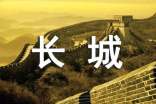
Everybody is good! Welcome to badaling scenic area tourism. Chen guided me today to visit with everyone, hope everybody can spend happy day in badaling.
Visitors, we now come to the front of a "dragon", it is - the Great Wall. From shanhaiguan east to west of jiayuguan, has more than thirteen thousand long! You stunned by is it now? Climb the Great Wall you will be more surprised, want to go? Then tell me Let, s go!
Dear visitors, now we come to the dragon's back, the dragon is built against the huge ChengZhuan and stone, and its back is very smooth, like a wide road, WuLiuPi horse can be parallel. You see, along the outside wall is two meters tall rows of buttress, t buttress on the square at the mouth and the nozzle, is for the benefit of the outlook and shooting. In ancient times, when war between countries, we stood in the dragon's back. Bang, making the enemy out of the water.
Visitors, you can gently stroked the dragon of the dragon phosphorus, however, in order to protect the Great Wall was not damaged, you must not use cutter! To be a civilized tourists.
The beacon tower is below, see the beacon tower, and then tell you a story, balefire drama governors, the zhou dynasty had a king named you king zhou, he seems, there is a beautiful woman called praised her temper very strange, always don't smile, think of some way to you king. Then he lit a distress signal, the result of vassal to a trip to the white, but praised si ha ha laugh, you king is also very happy. But, really have an enemy to attack, you king lit the fire, but no one come, you king was killed.
长城的英文介绍2
Hello everyone! You are welcome to visit the Great Wall. As the saying goes, "no the Great Wall is not a true man."!" Today, I'll be your little guide and introduce the Great Wall to you. Of course, I hope you have a good time and have a good time.
Next, I'd like to introduce the general situation of the Great Wall.
The Great Wall was founded in the spring and Autumn period and the Warring States period. At that time, each vassal state built the Great Wall in its own territory for mutual defense. Qin Shihuang unified Chinese, intrusion defense of the northern Xiongnu, the vassal state of the the Great Wall will connect and extend the known as "the the Great Wall".
If you look you will find, the the Great Wall, the Great Wall is like a long, winding in the high mountains and lofty hills. From Shanhaiguan to the west of the east of Jiayuguan, a total of more than 13000.
If you look closer, you will find that the the Great Wall is so tall and sturdy, is built with huge stone and bricks. You see, the top of the wall was covered with a brick, very smooth, like a wide road. In ancient times, five or six carriages could run in parallel. While the wall is a row of those two meters high, those on etc.look-mouth and shoot square, at the time, this is to look out and shooting. The top of the walls, every more than 300 meters there is a square of the city of Taiwan, it is his fortress. When fighting, the city and the station can echo each other. The fort is also called Beacon Tower". In the "Beacon Tower", Zhou Youwang also had directed a "feudal war drama" in the history of drama.
If you stand in the the Great Wall, on the foot of the brick wall, leaning on the stone, you will not think of the ancient people built the the Great Wall? At that time, there were no trains, no cars, no cranes. They can only use the countless shoulders and countless hands, the pieces of a two thousand or three thousand pound stone, hard to step up the steep mountain. How many working people's wisdom and sweat, is condensed into this before does not see the head, not the tail after the Great Wall!
Well, let me introduce you here. Visitors are free to visit. I hope this magnificent project, the great miracle, will impress you. Enjoy your trip.
大家好!欢迎你们来游览长城。俗话说得好:“不到长城非好汉!”今天,我就来当你们的小导游,向您介绍长城。当然,我也希望您能玩得开心,玩得高兴。
接下来,我就来向您介绍长城的概况。
长城始建于春秋战国时期。那时,各个诸侯国为了互相防御,就在自己境内地方筑建长城。秦始皇统一中国后,为防御北方匈奴的入侵,便将各诸侯国的长城连接起来,并将其延长,号称“万里长城”。
您如果远望长城,就会发现,长城就像一条长龙,在崇山峻岭之间蜿蜒盘旋。从东头的山海关到西头的嘉峪关,共有一万三千多里。
如果您走近点看,就会发现,长城是那么高大坚固,是用巨大的条石和城砖筑成的。您看,城墙顶上铺着方砖,十分平整,像一条宽阔的马路。在古代,五六匹马车可以并行。而城墙外沿,有两米多高的成排的垛子,垛子上有方形的瞭望口和射口,在那时,这是来瞭望和射击的。而城墙顶上,每隔三百多米就会有一座方形的城台,那是屯兵的堡垒。打仗的时候,城台之间可以互相呼应。这堡垒,也叫“烽火台”。在这“烽火台”上,周幽王还曾经导演过一场“烽火戏诸侯”的历史闹剧。
如果您站在长城,踏着脚下的方砖,扶着墙上的条石,您会不会想起建造万里长城的.古代劳动人民呢?在那时,没有火车,没有汽车,也没有起重机。他们只能用那无数的肩膀和无数的手,将这一块块两三千斤重的条石,一步一步的艰难地抬上这陡峭的山岭。多少劳动人民的智慧和血汗,才凝聚成这前不见头、后不见尾的万里长城啊!
好了,我就介绍到这里吧。下面游客们可以自由参观,希望这项气魄雄伟的工程,这个伟大的奇迹能给您留下难忘的印象,祝您旅游愉快。
长城的英文介绍3
Hello everyone! I am a little guide today, welcome you to the the Great Wall today known to the world, hope the visit will give you memories.
The Great Wall, far away, looks like a long line. Between the mountains forest winding, from Shanhaiguan to the west of the east of Jiayuguan, ten thousand miles.
The Great Wall is located in the north of Beijing. It was built in the spring and Autumn period and the Warring States period. At that time, many states to defend themselves on the territory of their own place is a place to build the Great Wall. Since the Qin Shihuang unified China, intrusion defense of the northern Xiongnu, the vassal state of the the Great Wall will connect and extend the known as "the the Great Wall".
Today, we visited the the Great Wall, built in Badaling, tall and sturdy, is built with huge stone and bricks. The top of the wall was covered with a brick, very smooth, like the wide street, parallel five or six horses in ancient times. The walls were lined with outer wall two meters high, with extension etc.look-mouth and shot countless. On the wall, every more than 300 meters there is a fortress troops. When fighting, the two fortresses can echo each other.
Just look at this countless stone, there is a two thousand or three thousand pound. At that time, no train, no car, crane, the working people is relying on countless countless hands shoulder, step by step, a piece of land to the majestic and steep mountains carried these stone. How many working people's sweat and wisdom to condense before me head, but not the tail of the Great Wall!
The Great Wall, with the world, the one and only "to describe it, a little too much. Today, let's just wait until we get to the Great Wall." Enjoy its grandeur and splendor.
A man who is not a the Great Wall is not a true man!" Now, let's go to the Great Wall and feel his majesty!
大家好!我是今天的小导游,欢迎你来到举世闻名的万里长城,希望今天的参观能给大家留下美好的回忆。
长城,远远望去,像一条长龙。在崇山峻林之间蜿蜒盘旋,从东头的山海关到西头的'嘉峪关,有一万三千里。
长城位于北京的北面,始建于春秋战国时期。那时各个诸侯国为了互相防御,就在自己的境内地势险要的地方修筑长城。自从秦始皇统一中国后,为防御北方匈奴的入侵,便将各诸侯国的长城连接起来,并将其延长,号称“万里长城”。
今天,我们参观的这一段长城,修筑在八达岭上,高大坚固,是用巨大的条石和城砖筑成的。城墙顶上铺着方砖,十分平整,像很宽的马路,在古代五六匹马可以并行。城墙外沿是成排两米多高的城墙,外延上有着数不清的瞭望口和射门。城墙上,每隔三百多米就有一座屯兵的堡垒。打仗的时候,两座堡垒之间可以相互呼应。
单看这数不清的条石,一块就有两三千斤重。那时,没有火车、汽车,也没有起重机,劳动人民就是靠着无数肩膀、无数的双手一步步、一块块地将这些条石抬上这雄伟、陡峭的山岭的。多少劳动人民的血汗和智慧才凝聚成前不见头、后不见尾的万里长城啊!
长城,用“举世无双,独一无二”来形容它,一点也不过分。今天,就让我们怀着“不到长城等上它。”领略它的雄伟、壮观。
“不到长城非好汉!”现在,让我们一起去登长城,去感受他的雄伟吧!
长城的英文介绍4
A: hi! Good morning, everyone, I am the guide from you this time to Beijing, my name is xu, everybody call me xu guide. Today to visit the Great Wall, in addition to the beautiful pictures and good memories, please don't take anything. In addition to gently footsteps and heartfelt praise what also don't leave, thank you for your cooperation. Good, I also not much said, let's start this time travel.
I want you to look at behind tall, magnificent buildings is the Great Wall. Far see the Great Wall, it is like a long dragon, in the mountains to strict flies hovering between winds. The Great Wall, a total of more than thirteen thousand miles long, the Great Wall east of shanhaiguan, west to jiayuguan. Starting from Beijing, but in the more than one hundred came to the foot of the Great Wall. Let's side as he listen to me. We arrived the building on the badaling Great Wall. Ok, now, let's see, this bump on both sides of the thing called buttress, crib hollows called outlook on mouth, out of the wall with a square hole, called nozzle. Visitors see, every three hundred meters there will be a ChengTai, that is the bulwark of station troops, such as the enemy came and also can mutual echo, convey information.
You can now take pictures, meet here five minutes, please pay attention to safety.
Today a day is over, please remember me, bye!
长城的英文介绍5
The Great Wall is a amazing miracle.It stands for the brave and diligent people of China.It was first built in Qin Dynasty with a length of 12700 kilometres.There is a beacon fire tower every 400 metres and the Bada Ling Beacon Fire Tower is the highest of all.The Great Wall is listed as a world culture legacy by the UNESCO.The Great Wall belongs to China and belongs to t。
长城的英文介绍6
Good morning! My name is Chen Ying snow, carefree travel guide, today is a great pleasure to serve you, you can call me snow! Today we are going to visit the Great Wall of landscape is famous in the world. The Great Wall is the world's precious historical relics, hope everyone to love the Great Wall, don't litter scribble, oh!
The Great Wall has a long history, a history of more than 20xx years, the spring and autumn period and the warring states period, the warring states to mutual defense, has built the Great Wall in the dangerous place. According to records zuozhuan: in 656 BC, "chu mahjong layout" is about the earliest record of the Great Wall. Out the six nations after the unification of China, qin to defense the north south invasion of the huns, in 224 BC, the qin, zhao and yan in The Three Kingdoms of the north Great Wall, re-hung, coherent rise. Some west about (now min county, gansu province) north mountain, east to liaodong, which is commonly known as the "Great Wall", still remains. Since then, the han, the northern wei dynasty, their, beiqi, sui dynasties had built the Great Wall. The composition
In Ming dynasty, in order to defense the invasion of alien, built the Great Wall before and after 18 times, total length of 6700 km, east of shanhaiguan, west to jiayuguan, today we visit this section of the Great Wall is built in the Ming dynasty, is located in the badaling.
Now we have arrived at the foot of badaling. Tourists friends, please look up at the Great Wall: it is like a huge dragon, winding between mountains. Please follow me to the Great Wall, see: every three hundred meters on the walls of the Great Wall there is a square ChengTai, is an ancient fortress to station troops. It is said that war, between the ChengTai can mutual echo. On the top of the walls are covered with very flat square brick, like a wide road, probably ErSanTai car can be parallel. Outside the wall along with many more than two meters high, the rows of the crenel, for? With hope and shot. The composition
My friends, have a look at your feet? Guess what weigh? Tell you! This is a stone, a piece of have two or three one thousand catties! At that time, there is no train, automobile, also have no crane, is by the shoulder of countless countless hands, step by step, carry on the steep mountains. This is how many working people sweat and wisdom, to condense into the former does not see the head, after see the tail of the Great Wall!
This is the Great Wall! This is the west jiayuguan, east to shanhaiguan, which meet the sea sunrise and gobi desert sun, or turned on the peaks, or bent over in the valley, the ups and downs, stretching thousands of miles of the Great Wall. It is such a magnificent verve, Great Wall is a great miracle in the history of the world!
Dear visitors, today's visit here will be over, thank you very much for my support and cooperation. The majestic Great Wall forever awaits respectfully you the presence!
长城的英文介绍7
The Great Wall, like the Pyramids of Egypt, the Taj Mahal(1) in India and the Hanging Garden of Babylon(2), is one of the great wonders of the world. Starting out in the east on the banks of the Yalu River in Liaoning Province, the Wall stretches westwards for 12,700 kilometers to Jiayuguan in the Gobi desert, thus known as the Ten Thousand Li Wall in China. The Wall climbs up and down, twists and turns along the ridges of the Yanshan and Yinshan Mountain Chains through five provinces-Liaoning, Hebei, Shanxi, Shaanxi, and Gansu--and two autonomous regions--Ningxia and Inner Mongolia, binding the northern China together.
Historical records trace the construction of the origin of the Wall to defensive fortification back to the year 656 B.C. during the reign of King Cheng of the States of Chu. Its construction continued throughout the Warring States period in the fifth Century B.C. when ducal states Yan, Zhao, Wei, and Qin were frequently plundered by the nomadic peoples living north of the Yinshan and Yanshan mountain ranges. Walls, then, were built separately by these ducal states to ward off such harassments. Later in 221 B.C., when Qin conquered the other states and unified China, Emperor Qinshihuang ordered the connection of these individual walls and further extensions to form the basis of the present great wall. As a matter of fact, a separate outer wall was constructed north of the Yinshan range in the Han Dynasty(206 BC--1644 BC.), which went to ruin through years of neglect. In the many intervening centuries, succeeding dynasties rebuilt parts of the Wall. The most extensive reinforcements and renovations were carried out in the Ming Dynasty (1368--1644) when altogether 18 lengthy stretches were reinforced with bricks and rocks. it is mostly the Ming Dynasty Wall that visitors see today. The Great Wall is divided into two sections, the east and west, with Shanxi Province as the dividing line. The west part is a rammed earth construction, about 5.3 meters high on average. In the eastern part, the core of the Wall is rammed earth as well, but the outer shell is reinforced with bricks and rocks. The most imposing and best preserved sections of the Great Wall are at Badaling and Mutianyu, not far from Beijing and both are open to visitors. The Wall of those sections is 7.8 meters high and 6.5 meters wide at its base, narrowing to 5.8 meters on the ramparts, wide enough for five horses to gallop abreast. There are ramparts, embrasures, peep-holes and apertures for archers on the top, besides gutters with gargoyles to drain rain-water off the parapet walk. Two-storied watch-towers are built at approximately 400-meters internals. The top stories of the watch-tower were designed for observing enemy movements, while the first was used for storing grain, fodder, military equipment and gunpowder as well as for quartering garrison soldiers. The highest watch-tower at Badaling standing on a hill-top, is reached only after a steep climb, like "climbing a ladder to heaven". The view from the top is rewarding, hoverer. The Wall follows the contour of mountains that rise one behind the other until they finally fade and merge with distant haze. A signal system formerly existed that served to communicate military information to the dynastic capital. This consisted of beacon towers on the Wall itself and on mountain tops within sight of the Wall. At the approach of enemy troops, smoke signals gave the alarm from the beacon towers in the daytime and bonfire did this at night.
Emergency signals could be relayed to the capital from distant places within a few hour long before the invention of anything like modern communications. There stand 14 major passes (Guan, in Chinese) at places of strategic importance along the Great Wall, the most important being Shanghaiguan and Jiayuguan. Yet the most impressive one is Juyongguan, about 50 kilometers northwest of Beijing. Known as "Tian Xia Di YI Guan" (The First Pass Under Heaven), Shanghaiguan Pass is situated between two sheer cliffs forming a neck connecting north China with the northeast. It had been, therefore, a key junction contested by all strategists and many famous battles were fought here. It was the gate of Shanghaiguan that the Ming general Wu Sangui opened to the Manchu army to suppress the peasant rebellion led by Li Zicheng and so surrendered the whole Ming empire to the Manchus, leading to the foundation of the Qing Dynasty. (1644-1911) Jiayuguan Pass was not so much as the "Strategic pass Under the Heaven" as an important communication center in Chinese history. Cleft between the snow-capped Qilian Mountains and the rolling Mazong Mountains, it was on the ancient Silk Road. Zhang Qian, the first envoy of Emperor Wu Di of the Western Han dynasty (206 B.C-24 A.D), crossed it on his journey to the western regions. Later, silk flowed to the west through this pass too. The gate-tower of Jiayuguan is an attractive building of excellent workmanship. It has an inner city and an outer city, the former square in shape and surrounded by a wall 11.7 meters high and 730 meters in circumference. It has two gates, an eastern one and a western one. On each gate sits a tower facing each other. the four corners of the wall are occupied by four watch towers, one for each. Juyongguan, a gateway to ancient Beijing from Inner Mongolia, was built in a 15-kilometer long ravine flanked by mountains. The cavalrymen of Genghis Khan swept through it in the 13th century. At the center of the pass is a white marble platform named the Cloud terrace, which was called the Crossing-Street Dagoba, since its narrow arch spanned the main street of the pass and on the top of the terrace there used to be three stone dagobas, built in the Yuan Daynasty(1206-1368). At the bottom of the terrace is a half-octagonal arch gateway, interesting for its wealth of detail: it is decorated with splendid images of Buddha and four celestial guardians carved on the walls. The vividness of their expressions is matched by the exquisite workmanship. such grandiose relics works, with several stones pieced together, are rarely seen in ancient Chinese carving. The gate jambs bear a multi-lingual Buddhist sutra, carved some 600 years ago in Sanskrit(3), Tibetan, Mongolian, Uigur(4), Han Chinese and the language of Western Xia. Undoubtedly, they are valuable to the study of Buddhism and ancient languages. As a cultural heritage, the Wall belongs not only to China but to the world. The Venice charter says: "Historical and cultural architecture not only includes the individual architectural works, but also the urban or rural environment that witnessed certain civilizations, significant social developments or historical events." The Great Wall is the largest of such historical and cultural architecture, and that is why it continues to be so attractive to people all over the world. In 1987, the Wall was listed by UNESCO as a world cultural heritage site.
Notes:1. the Taj Mahal in India 印度的泰姬陵2. the Hanging Garden of Babylon 巴比伦的空中花园3. Sanskrit 梵语4. Uigur 维吾尔语
There stand 14 major passes (Guan, in Chinese) at places of strategic importance along the Great Wall, the most important being Shanghaiguan and Jiayuguan. Yet the most impressive one is Juyongguan, about 50 kilometers northwest of Beijing.
Known as "Tian Xia Di YI Guan" (The First Pass Under Heaven), Shanghaiguan Pass is situated between two sheer cliffs forming a neck connecting north China with the northeast. It had been, therefore, a key junction contested by all strategists and many famous battles were fought here. It was the gate of Shanghaiguan that the Ming general Wu Sangui opened to the Manchu army to suppress the peasant rebellion led by Li Zicheng and so surrendered the whole Ming empire to theManchus, leading to the foundation of the Qing Dynasty. (1644-1911) Jiayuguan Pass was not so much as the "Strategic pass Under the Heaven" as an important communication center in Chinese history. Cleft between the snow-capped Qilian Mountains and the rolling Mazong Mountains, it was on the ancient Silk Road. Zhang Qian, the first envoy of Emperor Wu Di of the Western Han dynasty (206 B.C-24 A.D), crossed it on his journey to the western regions. Later, silk flowed to the west through this pass too. The gate-tower of Jiayuguan is an attractive building of excellent workmanship. It has an inner city and an outer city, the former square in shape and surrounded by a wall 11.7 meters high and 730 meters in circumference. It has two gates, an eastern one and a western one. On each gate sits a tower facing each other. the four corners of the wall are occupied by four watch towers, one for each.
Juyongguan, a gateway to ancient Beijing from Inner Mongolia, was built in a 15-kilometer long ravine flanked by mountains. The cavalrymen of Genghis Khan swept through it in the 13th century. At the center of the pass is a white marble platform named the Cloud terrace, which was called the Crossing-Street Dagoba, since its narrow arch spanned the main street of the pass and on the top of the terrace there used to be three stone dagobas, built in the Yuan Daynasty(1206-1368). At the bottom of the terrace is a half-octagonal arch gateway, interesting for its wealth of detail: it is decorated with splendid images of Buddha and four celestial guardians carved on the walls. The vividness of their expressions is matched by the exquisite workmanship. such grandiose relics works, with several stones pieced together, are rarely seen in ancient Chinese carving. The gate jambs bear a multi-lingual Buddhist sutra, carved some 600 years ago in Sanskrit(3), Tibetan, Mongolian, Uigur(4), Han Chinese and the language of Western Xia. Undoubtedly, they are valuable to the study of Buddhism and ancient languages. As a cultural heritage, the Wall belongs not only to China but to the world. The Venice charter says: "Historical and cultural architecture not only includes the individual architectural works, but also the urban or rural environment that witnessed certain civilizations, significant social developments or historical events." The Great Wall is the largest of such historical and cultural architecture, and that is why it continues to be so attractive to people all over the world. In 1987, the Wall was listed by UNESCO as a world cultural heritage site.
【长城的英文介绍】相关文章:
英文个人介绍04-27
(优选)英文个人介绍08-25
英文个人介绍(必备)08-26
mba英文个人介绍02-28
英文个人介绍范文07-14
英文submit的用法介绍08-23
北京美食英文介绍07-13
个人介绍范文英文08-26
中英文个人介绍08-24